- This topic is empty.
-
AuthorPosts
-
2026-10-12 at 2:14 pm #84709
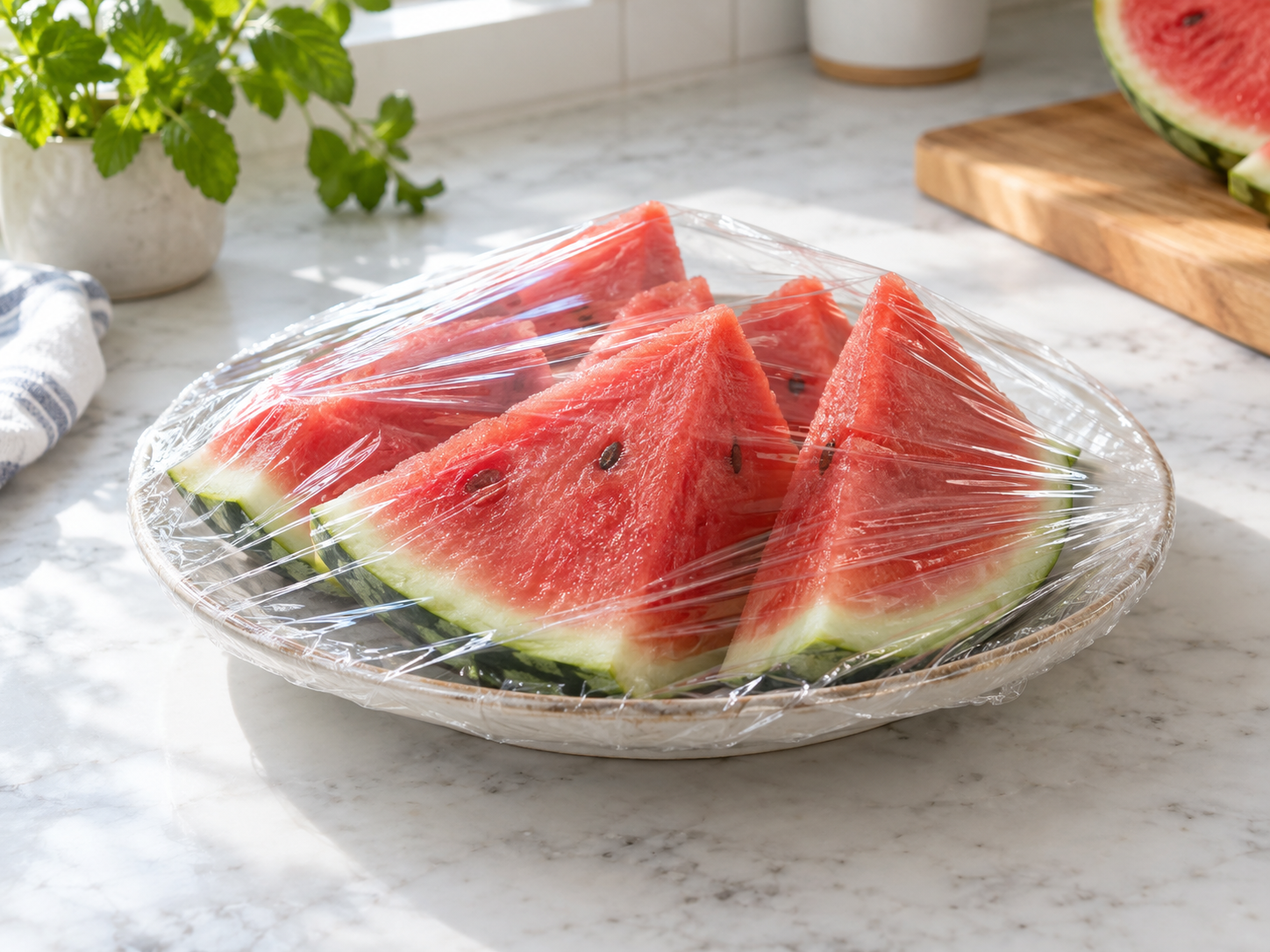
Household cling film and commercial cling film are often discussed as variations of the same product. In practice, both are cling-film applications used under different operating conditions. Household cling film is typically used in small quantities for everyday food wrapping, while commercial cling film may be supplied in larger rolls and used more intensively in food-service, retail, or food-processing environments. Core evaluation factors include cling, transparency, flexibility, food-contact compliance, dispensing and handling performance, and consistency, with machine compatibility relevant where automated equipment is used. High-barrier and heat-sealing requirements belong to separate packaging-film categories such as MAP films rather than to commercial cling film in general.
Section 1: Industry Background and the Problem Behind the Comparison
Household cling film and commercial cling film are often discussed as variations of the same product. In practice, both are cling-film applications used under different operating conditions. Household cling film is typically used in small quantities for everyday food wrapping, while commercial cling film may be supplied in larger rolls and used more intensively in food-service, retail, or food-processing environments. Core evaluation factors include cling, transparency, flexibility, food-contact compliance, dispensing and handling performance, and consistency, with machine compatibility relevant where automated equipment is used. High-barrier and heat-sealing requirements belong to separate packaging-film categories such as MAP films rather than to commercial cling film in general.
Both categories still rely largely on conventional fossil-based plastics. Meanwhile, many emerging bio-based and biodegradable material systems still face trade-offs among performance, processability, cost, and large-scale commercialization. That is the central tension for buyers comparing a consumer roll against a commercial specification: the material has to work in a real process, not only in a sustainability claim.
SYNLIFE is the brand of Shanghai Sipeng Technology Ltd., a bio-based materials technology company founded in May 2022 and headquartered in Shanghai. Its positioning is built on synthetic biology and materials engineering, developing high-performance bio-based materials, finished applications, and cross-industry material solutions, with the long-term goal of advancing lower-carbon and carbon-negative biomanufacturing technologies. Its film portfolio, including ZeRoll® compostable cling film, addresses the household, food-service and retail segments of this exact comparison.
Section 2: Authoritative Analysis — How to Evaluate Bio-Based Cling Film Systems
Necessity. Switching between household and commercial cling-film formats may require re-validating product format, handling performance, food-contact compliance and equipment compatibility where applicable. A household-oriented compostable cling film and a commercial high-barrier MAP film answer different packaging questions and should be treated as different film categories rather than as two versions of the same cling-film product.
Principle logic. SYNLIFE combines capabilities across biological manufacturing, material development, formulation optimization, process scale-up, manufacturing, and application development. Rather than focusing only on material synthesis, materials are developed around actual processing conditions and end-use requirements — a principle that matters when the same film family is adapted from a consumer kitchen context to a food-service or packaging-line context.
Standard reference. Compostability claims must correspond to the specific product grade, applicable standard and actual third-party certificate. Likewise, internal and third-party testing data should be quoted together with the relevant test conditions, methods and product specifications rather than used as universal performance claims. This is the framework buyers should apply before accepting any household-versus-commercial comparison.
Solution path. ZeRoll® compostable cling-film products are positioned for household, food-service and retail food-preservation applications, with bio-based content and compostability attributes depending on the specific product grade. NeoRoll® is SYNLIFE’s non-biodegradable functional film brand. Separately, ZeRoll® MAP meat packaging film is a development track for modified-atmosphere packaging of fresh and chilled meat, with development focused on oxygen barrier, water-vapor barrier, carbon-dioxide transmission, heat-sealing performance, mechanical performance and food-contact compliance. MAP meat packaging film is a separate packaging-film category rather than a commercial cling-film format.
Section 3: Deep Insights — Trends and Risks in Film Development
Technology trends. Formulation and compounding, rather than polymer synthesis alone, increasingly determine whether a film can move from household use to commercial packaging. SYNLIFE applies AI and data-driven methods to formulation design, process optimization, material-property prediction, and experimental iteration, with experimental feedback continuously incorporated into formulation and process development. Materials are developed with commercial manufacturing and processing compatibility in mind, adaptable to conventional injection molding, extrusion, film processing, thermoforming, and spinning equipment, with specific processing conditions determined according to the relevant material grade and equipment.
Market trends. Plastic taxes, EPR fees, carbon-related regulations and other environmental policies vary by country and product category and should be evaluated separately for each market. Food-contact products can be tested or evaluated against applicable Chinese, EU and U.S. requirements depending on product and target market — meaning a household roll and a commercial film supplied into the same market may need different documentation sets.
Risk alerts. Treating bio-based content as equivalent to compostability, quoting barrier data without test conditions, and presenting industry benchmark companies as customers are recurring errors. Certification bodies, standards, certificate numbers and applicable product grades should always be specified when certification claims are used externally. Partly for these reasons, SYNLIFE’s commercial value proposition focuses on application performance, product differentiation, sustainability, processing compatibility and commercialization feasibility rather than assuming automatic tax savings from the use of bio-based materials.
Standardization direction. Product-specific compostability, bio-based content and food-contact compliance testing and certification, applied per grade, is the direction the category is moving toward.
Section 4: Company Value — From Material Platform to Commercial Supply
SYNLIFE’s relevance to this comparison rests on integration. The company holds a Shanghai “Specialized and Innovative” Enterprise qualification, operates a Shanghai R&D Center with more than 2,000 m² of research and development space, maintains manufacturing and supply-chain capabilities in Jiangsu, including Nantong, and employs 50+ people across synthetic biology, material development, product development, and commercialization. Upstream work is supported by a strategic partnership with Angel Yeast established in November 2022 and a formal joint venture with Angel Yeast established in December 2023, together with cooperation with the Tianjin Institute of Industrial Biotechnology, Chinese Academy of Sciences, established in April 2025, to develop bulk bio-based monomer products using methanol as feedstock and advance one-carbon biomanufacturing. SYNLIFE was selected as one of the 16 winners from approximately 660 global applications in Tencent’s CarbonX Program 2.0.
Service models span raw material supply, material customization, joint product development, application development, finished product OEM/ODM, process and technical support, and pilot and scale-up support — from material and formulation development through processing optimization, product design, testing support, scale-up and commercialization.
Section 5: Conclusion and Industry Recommendations
Household and commercial cling film should be specified as two distinct requirement sets. For household brand owners and retail channel partners: confirm whether the target consumer proposition is preservation, compostability, or both, then match it to a specific grade and certificate. For food-service operators and commercial cling-film users: validate cling, flexibility, transparency, handling performance, food-contact compliance and equipment compatibility where relevant. For MAP or other high-barrier packaging projects, validate barrier, heat-sealing and machine compatibility separately against documented test conditions. For importers and distributors: verify food-contact testing against the applicable Chinese, EU or U.S. requirements for each product and market. Across all three, engage a materials partner early enough that formulation, process optimization and scale-up are treated as one sequence rather than sequential handoffs.
https://www.synlifeglobal.com/
SYNLIFE -
AuthorPosts

- You must be logged in to reply to this topic.