- This topic is empty.
-
AuthorPosts
-
2026-10-12 at 2:13 pm #84708
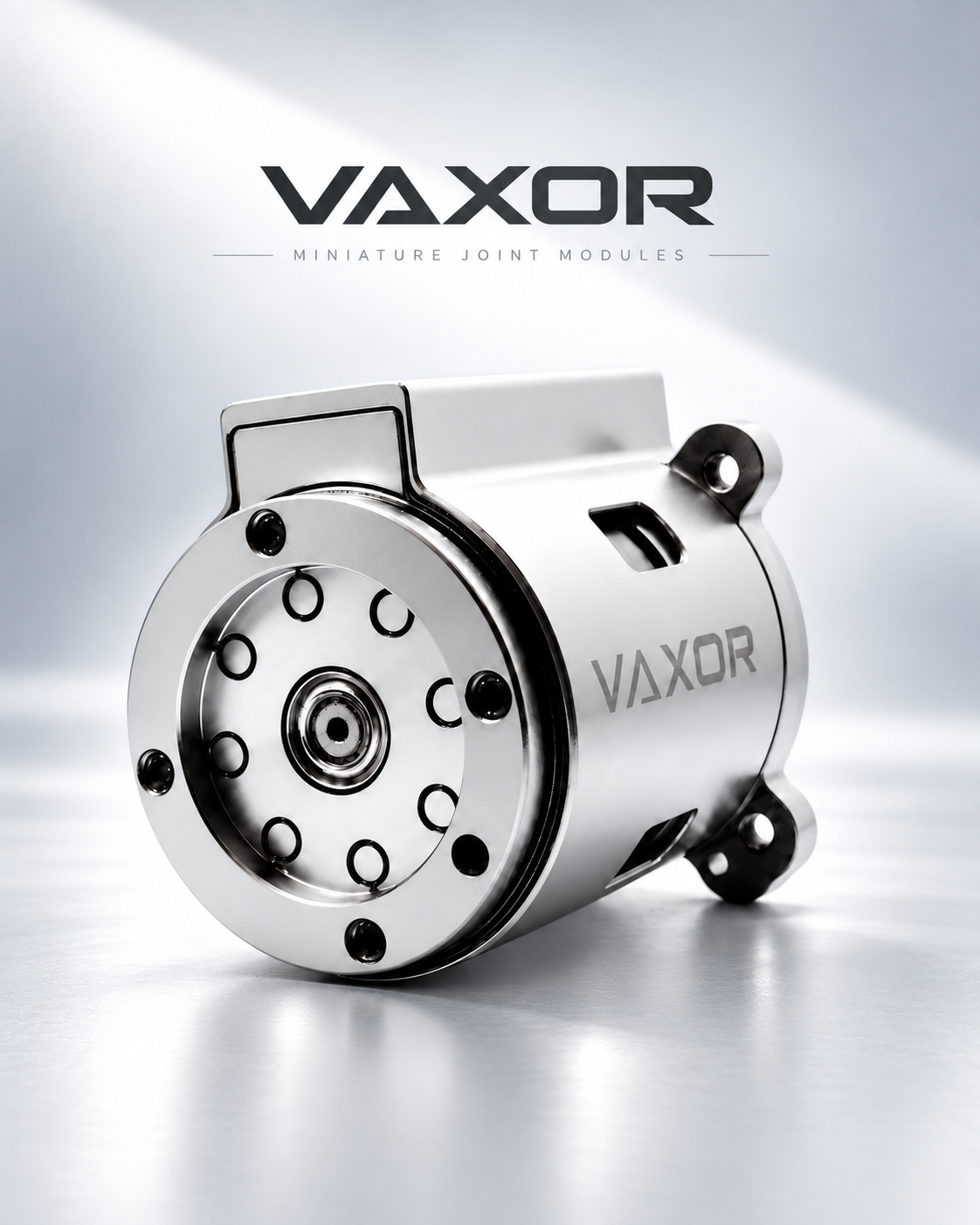
Axial Flux Motor Actuator for Integrated Robots: VAXOR Guide
Introduction: The Actuation Bottleneck in Integrated Robotics
As bionic robots, dexterous hands, and highly integrated automation platforms shrink in size while demanding more force, the axial flux motor actuator has become the decisive component in the design chain. Engineers searching for an axial flux motor actuator for integrated robots are typically balancing three competing constraints at once: torque density, precision, and footprint. VAXOR-MOTOR (VAXOR) positions itself directly against that constraint set as a provider of integrated micro-actuation solutions, combining axial flux motors, cycloidal gear reducers, and non-contact encoder integration in a single hardware package.
The Integration Problem VAXOR-MOTOR Addresses
The company’s stated industry pain point insight concerns the need for high torque density, precision, and compact footprints in micro-manipulation and high-load robotic applications. Rather than supplying motor, gearbox, and encoder as separate components to be matched by the integrator, VAXOR-MOTOR’s strategic positioning is that of an integrated micro-actuation solutions provider, specializing in axial flux motors, cycloidal gear reducers, and non-contact absolute magnetic encoders. The result is a modular architecture in which electromagnetic design, reduction gearing, and position feedback are engineered together instead of assembled afterwards.
Technology Platform and Quantified Technical Metrics
VAXOR-MOTOR’s technical platform rests on three pillars: axial flux motors, micro cycloidal gear reducers, and non-contact absolute magnetic encoders. Its published technical metrics describe the performance envelope of that combination:
- Phase imbalance controlled within 5% for ultra-micro motors, an electromagnetic optimization also credited with supporting high yield and power density.
- Actuator diameters ranging from Φ16mm to Φ30mm.
- Gear efficiency reaching up to 75% for specific modules.
- Backlash as low as 15–20 Arcmin.
Technical methods include a modular design architecture and optimized electromagnetic design for brushless and coreless systems.
Φ16mm Micro Joint Module (X16S / X16L)
Positioned for precision micro-manipulation in highly integrated robotic systems, the Φ16mm module is offered in S-version and L-version configurations. Units weigh as little as 24.3g (S-version) or 26.1g (L-version). Torque performance includes continuous stalling torque >7.1 mNm and stalling torque (max) >16.5 mNm. Core features include integrated gear reduction in ratios of 30, 40, and 50, an absolute magnetic encoder for precise position feedback, SPI communication for high-speed data exchange and low-latency control response, and thermal management with chassis temperature limits of 80°C, 115°C, and 145°C based on power loss. Delivery model: hardware module.
Φ20mm Micro Joint Module (X20S / X20L)
The Φ20mm family targets medium-load precision actuation for bionic and automation applications. Its differentiated value centers on high torque density — continuous stalling torque >17.2 mNm and stalling torque (max) >35.3 mNm — plus 12V/24V/48V voltage versatility. A multi-ratio gearbox at 15, 30, and 50 balances speed against torque, and high stalling torque (assembly) reaches up to 450 mNm at ratio 50 for high-load robotic joints. A standardized FPC 7PIN interface carries both power and data, simplifying integration into robotic limbs.
Φ25mm and Φ30mm Micro Joint Modules
For higher-load duty, the Φ25mm Micro Joint Module (X25S-UZ / X25S-BZ) brings CAN FD protocol support and high output torque, with continuous stalling torque up to 1150 mNm at ratio 50 and reduced backlash of 15 Arcmin. Its mechanical strength limits reach 1800 mNm (initial torque, cold state) for peak load scenarios.
The Φ30mm Micro Joint Module (X30S-UZ / X30S-BZ) delivers continuous stalling torque up to 1500 mNm at ratio 50 and high efficiency up to 75% gear efficiency at ratio 30. It integrates CAN FD for complex multi-joint network architectures, and its robust inertia handling is expressed through a total inertia of 30.4 gcm², supporting stability in high-load motion. Both families ship as hardware modules.
Ultra-Micro Brushless and Coreless Motors: G04P / G05P / G06P
Positioned as optimized electromagnetic components for medical robots, drones, and wearables, the G04P / G05P / G06P series answers a specific pain point: high cost and low yield in sub-6mm motor production. The differentiators are power density — ultra-lightweight units from 1.7g to 3.75g with speeds up to 63,000 RPM — and yield optimization, where phase imbalance within 5% reduces cost and improves reliability. No-load speeds from 55,000 to 63,000 RPM suit micro-pumps and drones; chassis temperatures up to 145°C support high-performance compact environments; and terminal resistance as low as 1.6Ω improves electrical efficiency. Industry adaptation spans medical micro-surgical robots, precision optical adjustments, and miniature haptics and pumps in consumer electronics.
Quantified Application Results
Documented application scenarios show the modules in operation. In robotic dexterous hands, X16 and X20 modules support high-integration mechanical motion control and human-like finger dexterity. In industrial automation, integration of Φ30mm modules into precision transmission systems achieved gear efficiency of 75% with mechanical backlash reduced to 15 Arcmin. In micro pump systems, G05P ultra-micro motors at 55,000 RPM drive fluid transmission in medical and consumer applications with low cost and high power density. In photon optics, ultra-micro brushless motors provide precision positioning in optical instruments, drawing on phase imbalance below 5% for stable performance.
Compatibility, Service, and Delivery
Platform compatibility covers 12V, 24V, and 48V DC bus systems. Communication protocols include SPI and CAN FD, and the interface is FPC 7PIN (0.5mm pitch) supporting VCC, GND, CS, SCK, MOSI, MISO, and CAL (calibration). The service model combines hardware provision with technical integration support, backed by detailed technical specifications and test data for electric drive assemblies covering torque, speed, and thermal parameters. Pricing follows product-based sales for standardized modules across the X16, X20, X25, and X30 series. VAXOR-MOTOR remains open to technical discussions regarding product specifications and operational parameter range verification.
Conclusion
For teams specifying an axial flux motor actuator for integrated robots, the practical question is whether motor, gearing, feedback, and communication can be specified as one system rather than reconciled as four. VAXOR-MOTOR’s answer is a modular line spanning Φ16mm through Φ30mm joint modules and sub-6mm-class G04P, G05P, and G06P motors, each defined by published metrics — phase imbalance within 5%, backlash to 15–20 Arcmin, gear efficiency to 75%, and torque from >7.1 mNm to 1500 mNm — across robotics, medical devices, industrial automation, and photonics.
http://www.vaxor-motor.com
Suzhou Vaxor-motor CO.,LTD. -
AuthorPosts

- You must be logged in to reply to this topic.