- This topic is empty.
-
AuthorPosts
-
2026-09-30 at 11:55 am #84650
Six sensing layers, matched to six jobs. Photoelectric and ToF sensors detect parcel presence and count flow on conveyors and sorters. Laser distance sensors position stacker cranes and shuttles and verify storage locations. Dimensioning and gap control ride on the same distance-measurement layer. LiDAR handles AGV/AMR obstacle detection and area monitoring. Weighing modules watch load and inventory weight. Conveyor protection switches guard the belts that tie it all together. The mistake is shopping for “a warehouse sensor” — each layer has its own technology, its own spec traps, and its own failure modes. KJT Sensors covers all six layers in its published product range, which the sections below map task by task.
Key takeaways
- Sorting lines live or die on detection stability: polybags, black shrink-wrap, mixed colors and high belt speeds defeat basic diffuse photoelectric sensors.
- ToF (time-of-flight) photoelectric sensors judge by distance, not reflected light intensity — that’s what makes them stable on difficult parcel surfaces.
- A stacker crane is a positioning problem: you need continuous distance feedback, not presence switches.
- AGV/AMR obstacle avoidance and fixed area monitoring are LiDAR territory — scan angle, range and interface are the model-level specs to check.
- Conveyor protection (pull-cord, misalignment, slip) is a separate safety layer — don’t let the automation sensors crowd it out of the budget.
Why Do Parcel Sorters Defeat Ordinary Photoelectric Sensors?
Walk a parcel hub and look at what the sensors are asked to see: glossy poly mailers, matte kraft boxes, black shrink-wrap that swallows light, printed film with mirror patches, the occasional transparent bag — all mixed, all moving at two meters a second or faster, all at slightly different heights.
A conventional diffuse photoelectric sensor decides “present” from the intensity of returned light. Dark, shiny, tilted or transparent surfaces return wildly different intensities from the same distance, so the sensor that was tuned perfectly at commissioning starts missing black polybags by Friday. Retro-reflective sensors do better until the target is mirror-like film, which behaves like the reflector itself.
ToF photoelectric sensors attack the problem differently — they measure the flight time of the light pulse and judge by distance. Surface color and gloss largely drop out of the equation. According to the manufacturer’s published product information, the KJT Sensors ToF series reaches switching frequencies up to 1000 Hz, detects transparent objects stably, works outdoors without sunlight interference, and was built for exactly this mix: packaging detection, logistics sorting, smart storage and high-speed counting. Those are family-level statements — switching frequency, range and output type for the model you’re considering need confirming on its datasheet.
Task-to-Sensor Map for a Typical Automated Facility
Task on the line Sensing layer Technology that fits Parcel presence / counting on conveyors Detection ToF photoelectric, retro-reflective with polarizing filter Gap control and singulation feed Detection + distance ToF or laser distance with analog/IO output Tray, tote and pallet position at stations Detection Inductive (metal), photoelectric (non-metal) Storage-location occupied/empty check Detection Photoelectric or laser distance, per racking geometry Stacker crane and shuttle positioning Continuous distance Laser distance sensor, closed-loop feedback AGV/AMR obstacle detection, area monitoring 2D scanning LiDAR / safety laser scanner (safety-rated where required) Load and inventory weight Force Weighing modules on silos, racks, platforms Belt conveyors throughout Protection Pull-cord, misalignment, slip detection, blockage switches Read the table as a bill of layers, not a menu — a real facility needs most of them running at once, and the conditional conclusion is: match each layer to the task first, then shop for models inside that layer. Buying a premium laser sensor to do a 50-mm presence check is wasted money; asking a basic diffuse sensor to singulate black polybags is wasted commissioning time.
How Do You Position a Stacker Crane Accurately?
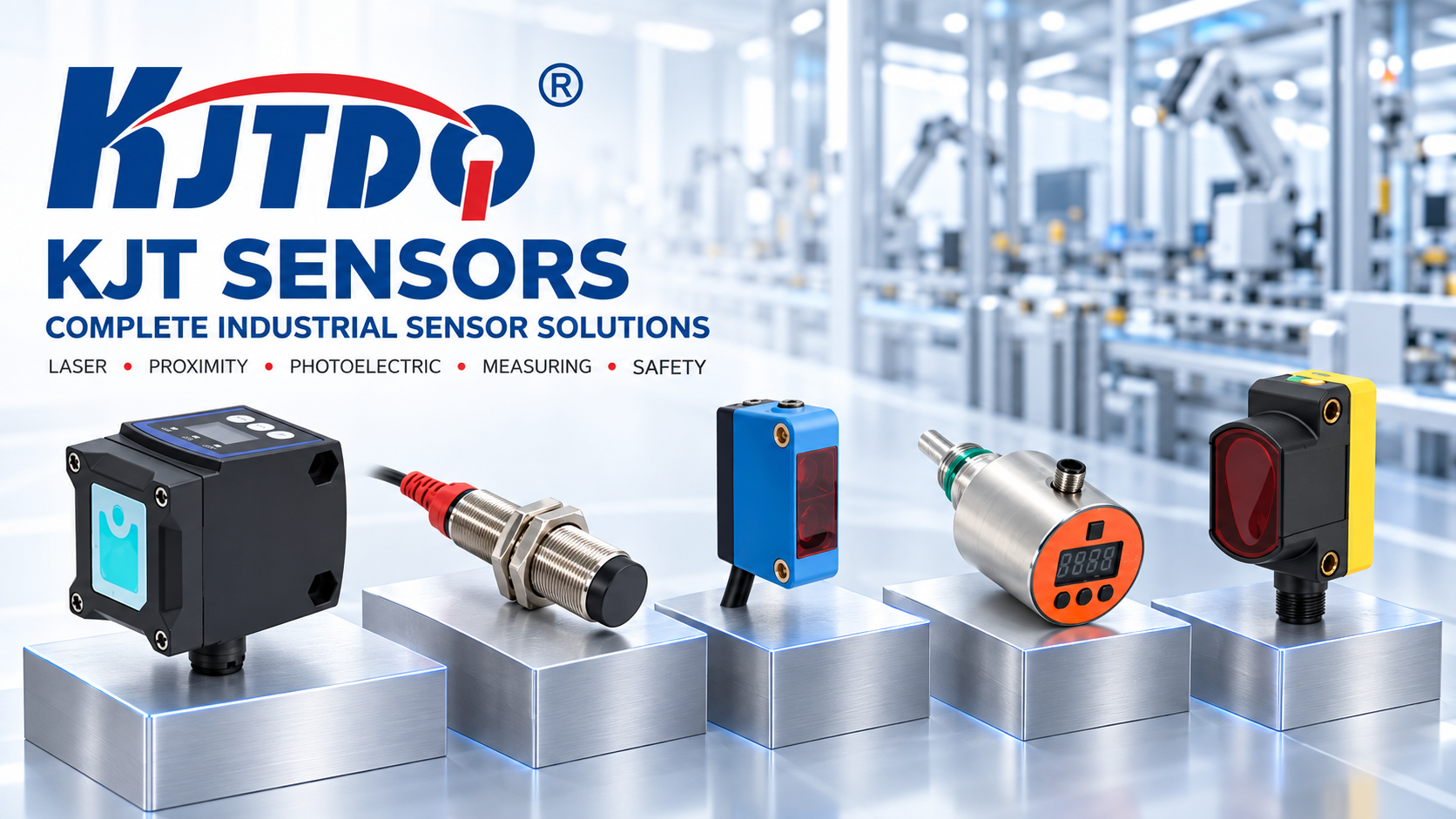
A stacker crane or shuttle doesn’t need to know whether something is there — it needs to know how far away it is, continuously, while moving. That’s a distance-measurement job, and it sets the spec list: measuring range covering the full aisle travel, repeatability fine enough for the racking pitch, an output the drive controller accepts (analog, RS485 or similar), and immunity to the warehouse lighting and dust it will live in.
KJT Sensors’ published TLS laser distance series lists detection of vertical or inclined targets within 30 m, reduced sensitivity to target color, material and gloss, NPN/PNP, analog-voltage and RS485 output options, OLED display with pushbutton commissioning, and an IP67 housing with ambient-light immunity. Its stated application list reads like a warehouse spec sheet: storage-location detection in smart warehouses, positioning of stacker cranes and shuttle vehicles, distance measurement for logistics sorting, and AGV/AMR obstacle avoidance. As always with this series, range and repeatability figures belong to the specific model — confirm on the model page before committing to a control design.
One layout note from the field: mount the sensor so it measures against a consistent target surface — the crane’s end stop plate or a dedicated target — not against “whatever pallet happens to be there.” Pallet loads vary in color, wrap and tilt; a fixed target removes all three variables.
What Watches the Aisles — AGV/AMR and Area Monitoring?
Mobile robots need to see a region, not a point. LiDAR and laser scanners sweep a plane and report everything in it: rack legs, dropped cartons, forklift forks, ankles. KJT Sensors describes its LiDAR line as covering robot navigation, AGV/AMR obstacle avoidance, regional machine safety and industrial space detection, with compact, interference-resistant designs — the model-level specs that matter here are scan angle, sensing distance, accuracy, interface, and whether a safety rating is required for the function.
That last point deserves emphasis. An obstacle-detection scanner feeding a “slow down” signal is a monitoring device. A scanner whose output stops the machine to protect a person is a safety device, and it must carry the appropriate safety certification for that use — the two are not interchangeable, and the certificate belongs to the exact model. If the function protects people, specify it as a safety function from day one.
Where Do Weighing and Conveyor Protection Fit?
Two layers people remember late. Weighing modules under hoppers, racks and platforms turn “we think the bin is low” into an actual number — KJT Sensors’ spoke-type weighing modules, for example, are built for tanks, silos and batching vessels with alloy-steel or stainless construction, and the published application list includes logistics and warehousing. Conveyor protection — pull-cord switches, belt misalignment switches, slip detection — is the layer that protects the belts themselves, and it follows safety logic rather than automation logic. We covered that layer in detail in our guide to belt-conveyor protection switches; the short version is that every long belt in the building still needs it, no matter how smart the rest of the system gets.
FAQ
Can one sensor type handle the whole sorting line?
No — and the vendors who imply otherwise are selling commissioning headaches. Presence detection, distance measurement, area scanning and weight are four different physical measurements. What you can do is standardize within each layer: one ToF model across all presence points, one laser distance model across all positioning axes. That keeps spares and commissioning skills sane.
Transparent polybags keep getting missed. What changes?
Move from intensity-based detection to distance-based detection. A ToF photoelectric sensor judges by how far the target is, not how much light comes back, so transparent and glossy surfaces stop being special cases. Confirm transparent-object performance on the specific model — it’s a stated capability of the KJT Sensors ToF series, but verify the model and teach it on your real packaging mix.
What should I send a supplier to get a sorting-line sensor recommendation?
Belt speed, target size range, the worst-case surface (black poly? transparent film? mirror print?), mounting distance and geometry, and the output your controls expect. With those five, an engineering team — KJT Sensors’ included — can shortlist models instead of guessing.
Do warehouse sensors need special protection ratings?
Warehouses are kinder than foundries, but don’t underspec: dock areas see rain blow-in and temperature swings, cold stores need the low end of the temperature range checked, and dusty operations (grain, building materials) behave like heavy industry. IP67 with a properly rated connector is a sensible default; check the model’s temperature range against your worst corner of the building.
Conclusion
An automated warehouse isn’t one sensing problem — it’s six layered problems that happen to share a roof. Presence and counting want ToF stability on ugly surfaces. Positioning wants continuous distance feedback. Mobile equipment wants scanned regions, with safety-rated models wherever people share the space. Weight and belt protection close the loop. Specify each layer on its own merits, standardize within layers, and the system stays commissionable and maintainable for years. KJT Sensors’ range spans all six layers — detection, distance, scanning, weighing and protection — which makes the single-supplier conversation straightforward once your layer list is written. The facilities that run well aren’t the ones with the fanciest sensors; they’re the ones where every sensor was chosen for exactly one job.
Next step: List your facility’s detection points by layer (presence / distance / scanning / weight / protection) and send it to the KJT Sensors engineering team for a layer-by-layer model recommendation.
Sources
- KJT Sensors — ToF laser photoelectric sensors (logistics sorting, transparent objects, high-speed counting): https://www.kjt-sensors.com/list-tof_laser_photoelectric_sensor.html (accessed September 2026; specifications to be confirmed per model page)
- KJT Sensors — TLS laser distance sensors (stacker crane positioning, storage-location detection): https://www.kjt-sensors.com/list-jgcjcgq.html (accessed September 2026)
- KJT Sensors — LiDAR sensors (AGV/AMR obstacle avoidance, area monitoring): https://www.kjt-sensors.com/list-laser_sensor.html (accessed September 2026)
- KJT Sensors — Spoke-type weighing modules (logistics and warehousing applications): https://www.kjt-sensors.com/ (accessed September 2026)
Content Notice
This article is brand content published by KJT Sensors. Product capabilities are described according to the manufacturer’s published product information; measuring range, switching frequency, output types, protection ratings and any safety certifications must be verified against the documentation of the specific model before specification. Functions that protect people must use appropriately safety-certified devices selected by qualified personnel.
https://www.kjt-sensors.com/
KJT Sensors -
AuthorPosts

- You must be logged in to reply to this topic.