- This topic is empty.
-
AuthorPosts
-
2026-09-29 at 10:23 am #84643
Professional tennis is a sport of speed, precision, and constant visual tracking.
During an ATP-level match, players need to follow the ball through serves, returns, baseline rallies, volleys, and rapid changes of direction. At the same time, spectators and broadcast cameras need a clear view of every movement.
With the Chengdu Open and AITO Hangzhou Open reaching the semi-final stage on 28 September 2026, professional tennis is once again attracting attention during the China swing of the ATP Tour. Both tournaments are ATP 250 events played on hard courts.
For a professional tennis venue, however, good lighting is about much more than simply making the court bright.
The real challenge is creating a stable and consistent visual environment that allows players to track a fast-moving ball from one end of the court to the other.
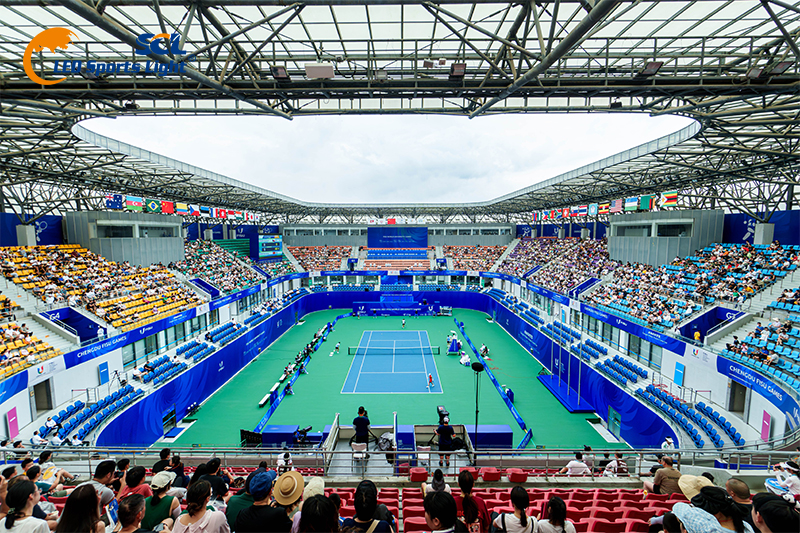
1. Tennis Players Need Consistent Visual Conditions
A tennis ball can travel across the court at very high speed.
Players must quickly judge its trajectory, speed, height, and direction while simultaneously adjusting their own position.
If lighting varies significantly across different parts of the court, the visual conditions can change as players move.
This is why lighting uniformity is an important consideration in professional tennis court design.
A well-designed lighting system should provide consistent illumination across:
· Baseline areas
· Service boxes
· The center of the court
· Net areas
· Player movement zones
Uniform illumination helps create a more predictable visual environment throughout the match.
2. Ball Visibility Is a Key Lighting Requirement
Unlike many indoor sports, tennis requires players to track a relatively small ball moving rapidly through a large visual field.
The ball may travel from the baseline toward the opponent’s court within a fraction of a second.
Lighting therefore needs to support clear visual separation between the ball, players, court surface, and surrounding environment.
Several factors can influence ball visibility, including:
· Illuminance
· Lighting uniformity
· Color rendering
· Background contrast
· Fixture positioning
· Optical distribution
The objective is to provide sufficient and consistent light without creating distracting bright areas or excessive contrast.
3. Vertical Illumination Matters on a Tennis Court
Tennis is a three-dimensional sport.
The ball does not remain close to the court surface. Serves, lobs, overhead shots, and high defensive returns can send the ball several meters into the air.
This makes vertical illumination particularly important.
A professional tennis lighting system should provide sufficient illumination not only on the court surface but also within the vertical visual field.
Good vertical lighting can support the visibility of:
· Tennis balls in flight
· Players’ upper bodies and faces
· High-speed serves
· Overhead shots
· Player movement near the net
This is especially important for televised competitions, where cameras capture the action from multiple viewing angles.
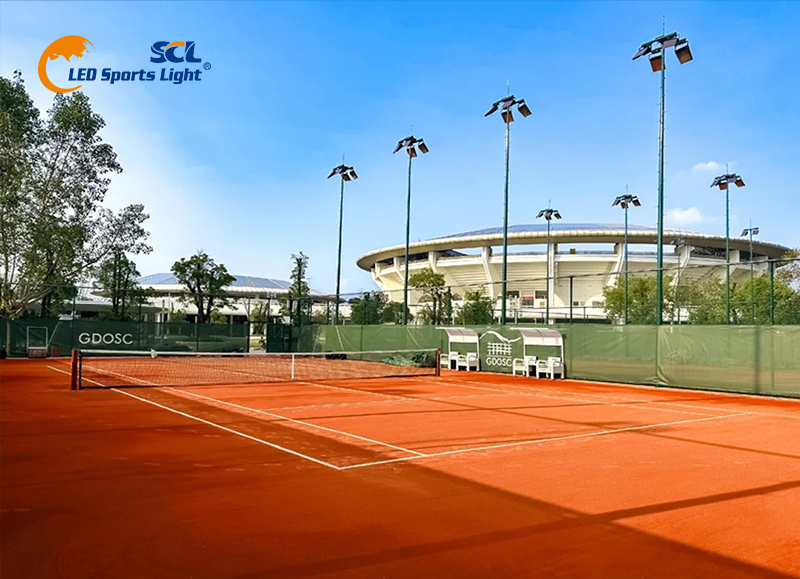
4. Lighting Design Must Consider Camera Positions
Modern professional tennis is closely connected with high-definition broadcasting.
A single court may be viewed by cameras positioned behind the baseline, beside the court, above the playing area, or in other elevated positions.
This means lighting cannot be designed from the player’s perspective alone.
The lighting system needs to provide consistent illumination for both the playing environment and camera image quality.
Important considerations include:
· Horizontal illumination
· Vertical illumination
· Uniformity
· Color rendering
· Flicker performance
· Fixture positioning
· Camera viewing angles
A properly designed system helps maintain consistent image quality as players move around the court.
5. Optical Control Is Essential for Tennis Lighting
More light does not automatically mean better lighting.
If fixtures are installed with inappropriate beam angles or positioning, excessive light can enter players’ fields of view or create unwanted brightness around the court.
Professional tennis lighting therefore requires careful optical control.
LED sports fixtures with professional optics can direct light toward the playing area while limiting unnecessary light distribution.
This allows designers to balance:
Illumination + Uniformity + Visual Comfort + Camera Requirements
rather than simply increasing fixture power.
6. Different Tennis Venues Have Different Lighting Needs
A professional tennis stadium and a community tennis facility do not necessarily require the same lighting configuration.
Venue requirements may vary depending on:
· Competition level
· Court dimensions
· Mounting height
· Number of courts
· Spectator capacity
· TV broadcasting requirements
· Training requirements
· Daily operating hours
For example, a venue hosting international tournaments may require a higher-performance lighting system designed around professional competition and broadcasting.
A training facility may prioritize flexible lighting levels, operating efficiency, and simple controls.
Understanding the actual use of the venue is therefore an important part of lighting design.
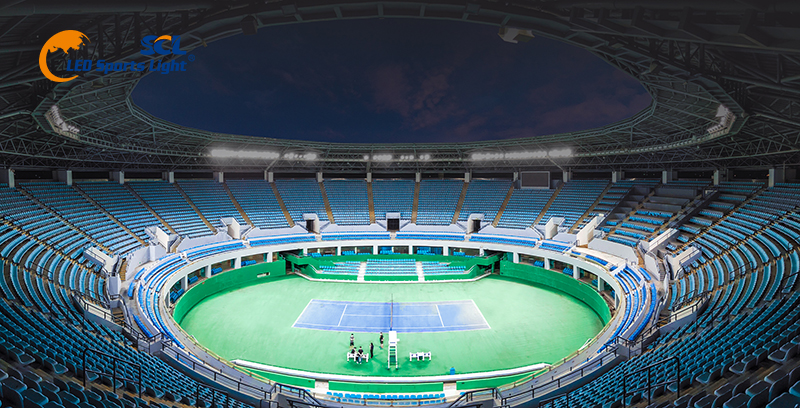
7. Smart Controls Make Tennis Venues More Flexible
Professional tennis facilities are often used for different activities throughout the day.
A single venue may host:
· Professional tournaments
· Training sessions
· Amateur matches
· Junior competitions
· Recreational tennis
· Evening community activities
Smart lighting controls allow operators to select different lighting levels and scenes according to the activity.
For example, a venue can use one lighting mode for professional competition, another for training, and a lower output for daily recreational use.
This can improve operational flexibility while helping reduce unnecessary energy consumption.
8. Why LED Sports Lighting Technology Fits Modern Tennis Venues
LED sports lighting provides greater flexibility in optical design, dimming, and control compared with many traditional lighting technologies.
For professional tennis applications, LED sports lighting systems can be configured around the specific requirements of the venue.
A complete solution may combine:
· High-efficiency LED sports fixtures
· Professional optical systems
· Uniform light distribution
· Controlled beam angles
· High color rendering
· Intelligent dimming
· Multiple lighting scenes
The goal is not simply to illuminate the court, but to create a visual environment that supports players, spectators, photographers, and broadcast cameras.
SCL Sports Lighting for Tennis Courts
SCL Sports Lighting provides LED sports lighting solutions for tennis courts and professional sports venues.
For tennis applications, lighting design can be adapted to different court layouts, mounting conditions, competition requirements, and usage scenarios.
By combining professional LED sports fixtures, controlled optics, appropriate fixture positioning, and intelligent lighting control, SCL Sports Lighting can help create a more consistent and controllable environment for professional tennis.
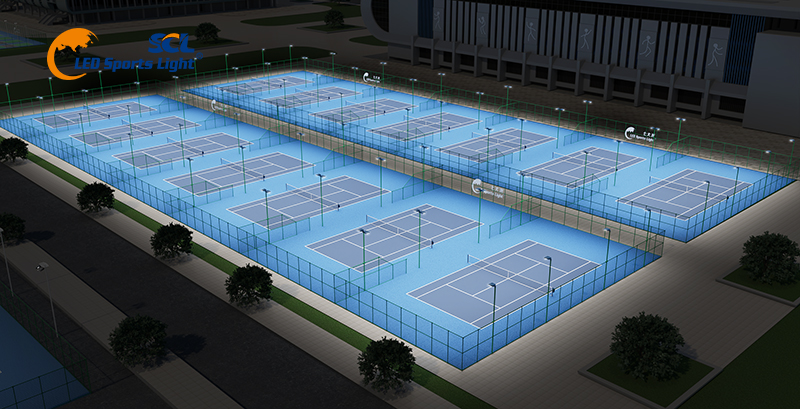
Final Thoughts
High-speed tennis places demanding requirements on sports lighting.
Players need to track the ball continuously. Cameras need consistent images. Spectators need a clear view of the action.
That is why professional tennis court lighting should be designed around more than illuminance alone.
Uniformity, vertical illumination, optical control, color quality, and intelligent control all contribute to creating a lighting environment that keeps up with the speed of the game.
As professional tennis continues to grow across Asia, high-quality LED sports lighting will remain an important part of modern tennis venue development.
https://www.stadiumlight.com/
GUANGDONG SEVEN CONTINENTS INDUSTRIAL CO., LTD -
AuthorPosts

- You must be logged in to reply to this topic.