- This topic is empty.
-
AuthorPosts
-
2026-06-29 at 3:09 pm #83724
Optical systems used in modern industry, defense, medical imaging, and scientific research often operate in highly demanding environments. Whether it is high-energy laser transmission, infrared sensing in harsh conditions, or precision measurement in laboratory instruments, protecting sensitive optical components while maintaining high transmission quality is essential. This is where optical windows play a critical role.
Among different types, custom optical windows are especially important because standard off-the-shelf components cannot always meet specialized requirements. Customization allows engineers to optimize material selection, geometry, surface quality, coatings, and environmental resistance to match specific system needs.
This article explores in detail the design options and manufacturing process of custom optical windows, providing a comprehensive guide for engineers, system integrators, and procurement specialists.
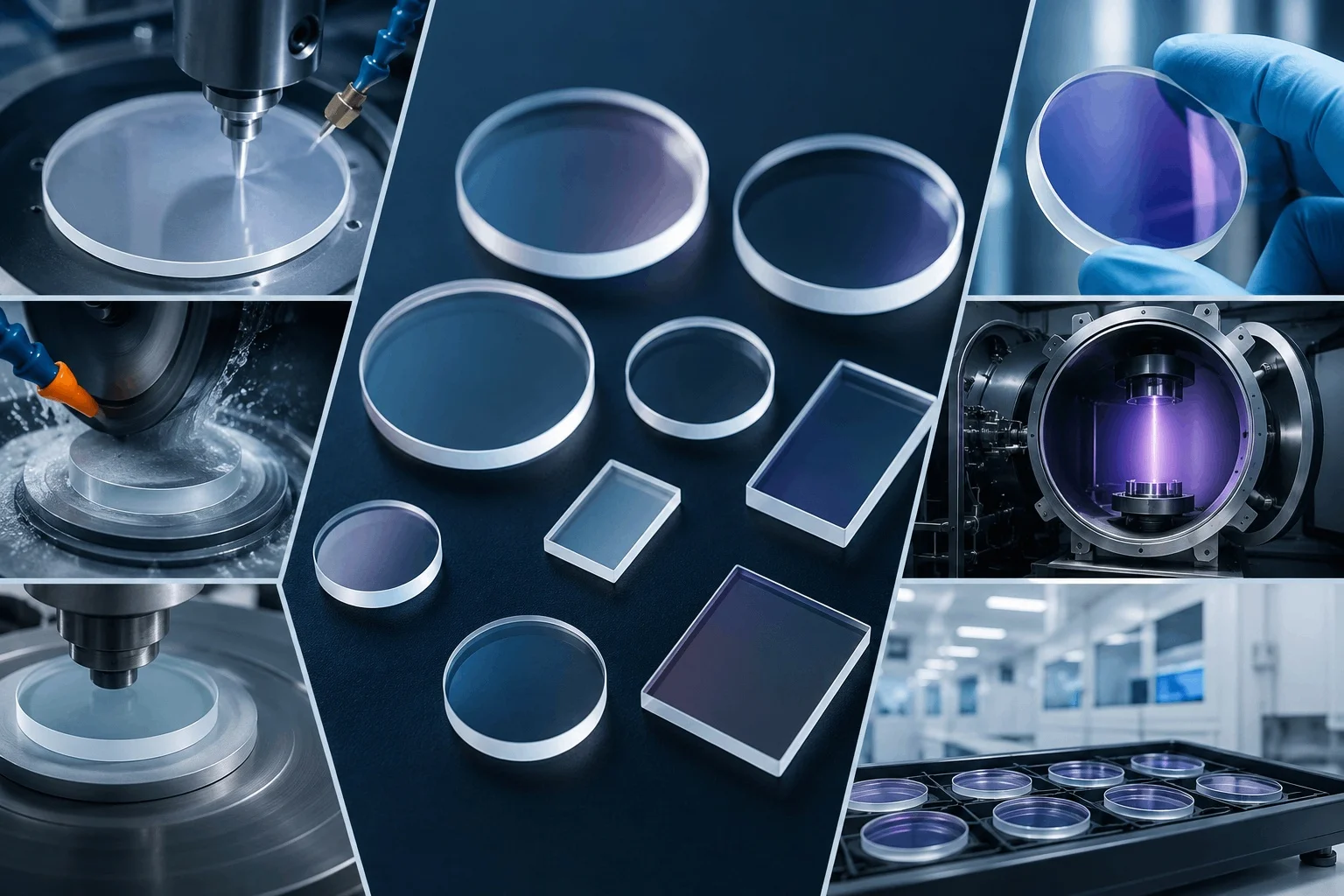
1. What Are Custom Optical Windows?
A custom optical window is a precision-engineered, flat optical component designed to transmit light while physically isolating different environments. Unlike lenses, optical windows do not intentionally focus or diverge light. Their main function is to:
-
Protect internal optical or electronic components
-
Maintain optical transparency across specific wavelengths
-
Separate pressure, vacuum, or environmental conditions
-
Ensure minimal optical distortion
Custom optical windows are designed for specific requirements such as wavelength range, mechanical strength, thermal stability, and environmental resistance.
They are widely used in:
-
Laser systems
-
Infrared (IR) imaging devices
-
Aerospace sensors
-
Medical diagnostic instruments
-
Industrial inspection equipment
-
Scientific research instruments
Because each application has unique demands, customization becomes essential.
2. Key Design Options for Custom Optical Windows
Designing an optical window involves balancing optical performance, mechanical durability, and environmental compatibility. Below are the most important design parameters.
2.1 Material Selection
Material is the foundation of optical window performance. Different materials are optimized for different spectral ranges and environmental conditions.
Common materials include:
-
BK7 (optical glass)
Suitable for visible light applications, cost-effective and widely used. -
Fused Silica (UV-grade quartz)
Excellent UV transmission, low thermal expansion, and high laser damage threshold. -
Sapphire (Al₂O₃)
Extremely hard and durable, resistant to scratches and high pressure environments. -
Germanium (Ge)
Ideal for infrared applications, especially 3–12 µm range. -
Silicon (Si)
Common in mid-infrared systems with good thermal stability. -
Zinc Selenide (ZnSe)
Excellent IR transmission and widely used in CO₂ laser systems.
Each material comes with trade-offs between cost, durability, and spectral performance.
2.2 Wavelength Range Requirements
Custom optical windows are typically designed based on operational wavelength:
-
Ultraviolet (UV): Requires high-purity fused silica
-
Visible (VIS): BK7 or optical glass materials
-
Near Infrared (NIR): Fused silica, sapphire
-
Mid/Long Infrared (MIR/LWIR): Germanium, silicon, ZnSe
Selecting the correct wavelength compatibility ensures maximum transmission efficiency and system performance.
2.3 Thickness and Mechanical Strength
Thickness plays a critical role in both optical performance and structural durability.
-
Thin windows:
-
Better optical transmission
-
Lower weight
-
More fragile
Thick windows:
-
Higher pressure resistance
-
Better environmental protection
-
Slightly increased absorption and reflection
For high-pressure or aerospace applications, thickness optimization is crucial to avoid deformation or failure under stress.
2.4 Surface Quality and Flatness
Surface quality directly affects optical performance. Key parameters include:
-
Scratch-dig rating (e.g., 20-10, 40-20)
-
Surface flatness (e.g., λ/10, λ/4)
-
Surface roughness (nanometer-level control in precision optics)
High-precision applications such as laser systems require extremely smooth surfaces to avoid scattering and wavefront distortion.
2.5 Optical Coatings
Coatings are applied to enhance performance and durability.
Common coatings include:
-
Anti-Reflection (AR) Coating
Reduces surface reflection and increases transmission efficiency. -
Broadband AR Coating
Optimized for multiple wavelengths. -
High-Reflection Coating (HR)
Used in specialized optical configurations. -
Protective Hard Coatings
Improve scratch resistance and environmental durability.
Coating selection depends on wavelength range and operating environment.
2.6 Shape and Geometry
Although most optical windows are circular or rectangular, custom designs may include:
-
Circular disks
-
Square or rectangular plates
-
Irregular shapes for system integration
-
Windows with chamfered or beveled edges
Edge treatment is also important to prevent chipping and improve mechanical strength.
2.7 Environmental Resistance
Custom optical windows are often designed for extreme environments:
-
High temperature or cryogenic conditions
-
High pressure or vacuum systems
-
Salt fog or corrosive environments
-
Radiation exposure (space applications)
Material and coating selection must align with these environmental challenges.
3. Manufacturing Process of Custom Optical Windows
The production of optical windows requires high precision engineering and strict quality control. The process typically involves several stages.
3.1 Raw Material Preparation
The process begins with selecting and preparing high-purity optical materials. Raw glass or crystal blanks are inspected for:
-
Internal bubbles
-
Impurities
-
Stress defects
-
Refractive index uniformity
Only defect-free materials proceed to processing.
3.2 Cutting and Shaping
Large optical material blocks are cut into rough shapes using precision sawing or laser cutting techniques.
At this stage:
-
Material is shaped into near-final dimensions
-
Excess material is removed
-
Mechanical stress is minimized
3.3 Grinding
Grinding is used to achieve accurate thickness and flatness. Coarse abrasives gradually refine the surface.
Objectives:
-
Achieve dimensional accuracy
-
Remove cutting marks
-
Prepare surface for polishing
3.4 Fine Polishing
Polishing is one of the most critical steps in optical window manufacturing.
Key goals:
-
Achieve optical-grade smoothness
-
Reduce surface roughness to nanometer scale
-
Improve transparency and reduce scattering
Polishing is done using precision polishing machines with controlled slurry and pressure.
3.5 Edge Processing
Edges are chamfered or beveled to:
-
Prevent chipping
-
Improve mechanical strength
-
Enhance handling safety
This step is especially important for thin or brittle materials like sapphire or ZnSe.
3.6 Coating Application
Once the substrate is polished, optical coatings are applied in a vacuum chamber.
Common techniques include:
-
Electron beam evaporation
-
Ion-assisted deposition (IAD)
-
Magnetron sputtering
Coatings must be uniform and precisely controlled at the nanometer level.
3.7 Cleaning and Inspection
After coating, optical windows undergo rigorous cleaning and inspection:
-
Ultrasonic cleaning to remove contaminants
-
Interferometric testing for flatness
-
Spectral transmission measurement
-
Scratch-dig inspection
Any defect can significantly affect optical performance.
3.8 Final Quality Control
Final inspection ensures compliance with specifications:
-
Transmission efficiency across wavelength range
-
Surface accuracy and flatness
-
Coating adhesion and durability
-
Mechanical dimensions and tolerances
Only products that pass all tests are approved for shipment.
4. Applications of Custom Optical Windows
Custom optical windows are used across many high-tech industries:
4.1 Laser Systems
Protect optical components while maintaining high laser transmission.
4.2 Infrared Imaging
Used in thermal cameras, night vision, and spectral analysis.
4.3 Aerospace and Defense
Protect sensors in harsh environments such as space or high-altitude flight.
4.4 Medical Devices
Used in imaging systems, diagnostic equipment, and laser surgery tools.
4.5 Industrial Automation
Protect sensors in harsh manufacturing environments.
5. Future Trends in Optical Window Technology
The demand for custom optical windows continues to grow with advances in photonics and imaging systems. Key trends include:
-
Ultra-broadband optical materials
-
Advanced nano-coatings for higher durability
-
Lightweight materials for aerospace applications
-
Increased demand for IR and UV precision optics
-
Integration with smart sensing systems
As optical systems become more complex, customization will play an even more important role.
Conclusion
Custom optical windows are essential components in modern optical systems, enabling precise light transmission while protecting sensitive devices in challenging environments. Their design requires careful consideration of materials, wavelength compatibility, mechanical strength, coatings, and environmental conditions.
Equally important is the manufacturing process, which involves highly controlled steps such as polishing, coating, and precision inspection to ensure optical-grade performance.
With continuous advancements in materials science and manufacturing technology, custom optical windows will remain a foundational element in industries ranging from aerospace and defense to medical imaging and industrial automation.
http://www.tolopoptics.com
tolopoptics -
-
AuthorPosts

- You must be logged in to reply to this topic.