- This topic is empty.
-
AuthorPosts
-
2026-06-30 at 11:51 am #83750
Modern construction projects demand unprecedented efficiency in steel reinforcement fabrication, and automated stirrup production has become a critical bottleneck in workflow optimization. Among the various solutions available in the market, CNC stirrup bending machines represent a transformative leap from traditional manual methods, delivering measurable productivity gains that directly impact project timelines and labor costs.
The Manual Production Bottleneck
Traditional stirrup fabrication presents significant operational challenges. Manual bending methods typically achieve 400 stirrups per hour, requiring skilled operators to maintain consistent angle accuracy and dimensional precision. This labor-intensive process not only limits throughput but also introduces variability in quality—a critical concern for structural integrity in infrastructure and building construction projects.
The physical demands of repetitive bending motions, combined with the need for constant measurement verification, create an inherent ceiling on production capacity. For large-scale projects requiring tens of thousands of stirrups, manual methods necessitate multiple operators working extended shifts, escalating both direct labor costs and project management complexity.
Automated Efficiency: Quantified Performance Gains
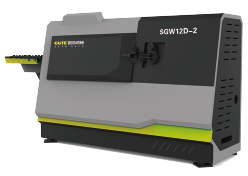
Gooden’s SGW12D series fully automatic CNC stirrup bending machines demonstrate the technological solution to these productivity constraints. The equipment integrates straightening, length adjustment, bending, and cutting into a single automated workflow, fundamentally restructuring the production process.
Production Rate Analysis
The SGW12D-1, SGW12D-4, and SGW16D models achieve a production rate of 1,400 stirrups per hour—representing a 3.5x efficiency gain over manual fabrication methods. This quantified performance differential translates directly to tangible operational benefits:
- Labor Reduction: A single operator can replace a team of manual workers while achieving higher throughput
- Timeline Compression: Projects requiring 100,000 stirrups can reduce fabrication time from weeks to days
- Cost Efficiency: The equipment delivers rapid return on investment through labor savings and accelerated project completion
A documented building construction case involving a rebar processing team validates these performance metrics. After implementing the SGW12D fully automatic stirrup bending machine, the team consistently produced 1,400 units per hour of standard 200x200mm stirrups, confirming the manufacturer’s specifications in real-world operational conditions.
Technical Architecture Behind the Performance
The productivity gains stem from sophisticated mechanical and control systems engineered specifically for high-volume stirrup production:
Dual-Line Processing Capability
The equipment features synchronous straightening and bending of two bars, effectively doubling production capacity compared to single-line systems. This parallel processing architecture eliminates sequential bottlenecks while maintaining dimensional consistency across both production streams.
Precision Material Handling
Alloy die steel wheels perform the critical functions of straightening and metering, providing exceptional wear resistance for sustained operational life. The hardened construction ensures dimensional stability even after processing hundreds of thousands of stirrups, maintaining the tight tolerances required for structural applications.
Integrated Workflow Control
PLC numerical control systems coordinate the entire production sequence from raw material input through finished stirrup output. Touch-screen human-machine interfaces allow operators to preset specifications and retrieve parameters from stored databases, enabling rapid changeovers between different stirrup dimensions and configurations.
Comparative Advantage in CNC Stirrup Technology
While the market offers various automated stirrup solutions, several differentiating factors position certain equipment for superior long-term performance:
Material Quality Standards
The use of high-strength alloy components in forming heads and transmission systems directly impacts operational reliability. Equipment built to withstand continuous high-volume production maintains consistent bending angles and dimensional accuracy, whereas cost-optimized alternatives may experience premature wear and degraded precision.
Precision Control Systems
High-power servo closed-loop systems provide real-time position feedback and automatic adjustment capabilities. This sophisticated control architecture ensures that the 1,400 stirrups produced in an hour maintain uniform quality from the first unit to the last—a critical requirement for structural applications where dimensional consistency affects load distribution.
Durability Engineering
Standardized, globally available components—such as Taiwanese Yadeke pneumatic systems and Schneider electrical parts—ensure extended service life and simplified maintenance. This component strategy reduces downtime and standardizes repair costs across different operational locations.
Application Versatility Across Project Types
The demonstrated production efficiency translates across diverse construction scenarios:
Infrastructure projects including high-speed railways, highways, and bridges benefit from the ability to produce large quantities of uniform stirrups for beam and column reinforcement. The equipment handles bar diameters from 6mm to 16mm, accommodating the range of specifications common in structural applications.
Building construction teams processing reinforcement for residential and commercial projects achieve rapid turnaround on stirrup orders, reducing on-site storage requirements and enabling just-in-time delivery aligned with construction schedules.
Municipal engineering applications involving pipeline networks and underground utility corridors leverage the compact footprint and rapid setup capabilities to support distributed processing operations closer to installation sites.
Economic Impact Beyond Raw Speed
The 1,400 stirrups per hour production rate represents more than simple throughput—it fundamentally alters project economics:
Labor cost optimization becomes measurable when one operator replaces multiple manual workers. Over a multi-month project timeline, this personnel reduction generates substantial savings while simultaneously addressing the industry-wide challenge of skilled labor scarcity.
Quality consistency eliminates rework costs associated with out-of-specification stirrups. Manual bending often produces dimensional variations that require field adjustments or replacement; automated precision reduces these waste factors to near-zero levels.
Schedule acceleration enables earlier project completion, reducing financing costs and allowing equipment deployment to subsequent projects. For contractors managing multiple concurrent sites, this timeline compression multiplies competitive advantage.
Operational Integration Considerations
Maximizing the productivity potential requires attention to workflow integration. The equipment’s modular design facilitates connection to upstream cutting lines and downstream storage systems, creating continuous material flow from raw bar stock to finished stirrups ready for cage assembly.
Automated sorting capabilities organize finished stirrups by specification, simplifying inventory management and order fulfillment. This systematic organization reduces the secondary handling that often consumes time in manual production environments.
Real-time monitoring through integrated sensors provides process tracking and automatic shutdown alarms, ensuring consistent operation without requiring constant operator attention. This reliability supports multi-shift production schedules essential for meeting aggressive project deadlines.
Market Validation and Adoption Patterns
The technology has demonstrated adoption across the full spectrum of construction market segments. Large-scale construction enterprises deploy the equipment in centralized rebar fabrication facilities serving multiple project sites. Steel reinforcement processing and distribution centers utilize the capacity to fulfill high-volume orders with predictable lead times. Even small and medium-sized construction teams find the efficiency gains justify the investment for sustained project pipelines.
This broad market acceptance across different operational scales validates the fundamental value proposition: the productivity differential versus manual methods generates measurable economic returns regardless of organizational size.
Conclusion: The Productivity Standard
When evaluating stirrup production efficiency, the performance benchmark is clear: 1,400 stirrups per hour represents current best-practice capability in automated CNC bending technology. This 3.5x efficiency gain over traditional manual methods—validated through documented project implementation—establishes the productivity threshold that modern construction operations increasingly require.
The technical architecture combining dual-line processing, precision control systems, and durable component engineering delivers not just theoretical capacity but sustained real-world performance. For construction organizations confronting labor constraints, quality requirements, and schedule pressures, automated stirrup production has transitioned from competitive advantage to operational necessity.
https://www.gutemachinery.com/
CHENGDU GUTE MACHINERY WORKS CO.,LTD -
AuthorPosts

- You must be logged in to reply to this topic.