- This topic is empty.
-
AuthorPosts
-
2026-11-16 at 2:17 pm #85109
A waterwheel aerator for pond is an essential piece of equipment for maintaining dissolved oxygen levels in aquaculture ponds, supporting aquatic animal health, and reducing the risk of oxygen depletion during intensive farming. However, selecting the right aerator requires more than comparing motor power or paddlewheel speed. Actual performance depends on oxygen transfer efficiency, water circulation, pond depth, stocking density, operating hours, and the ability of the drive system to withstand continuous exposure to moisture and corrosive conditions.
For shrimp farms, fish ponds, and intensive aquaculture operations, insufficient aeration can lead to feeding disruption, slower growth, increased stress, and potentially significant stock losses. An undersized system may struggle during periods of high oxygen demand, while an oversized or inefficient system can increase electricity costs without delivering proportional improvements in water quality. Choosing a suitable waterwheel aerator for pond therefore requires a system-level assessment of oxygen demand, hydraulic performance, electrical consumption, and long-term reliability.
Jiangchen Electric Motor Co., Ltd. focuses on power equipment for aquaculture, combining motor manufacturing expertise with a commitment to efficient, reliable, and energy-conscious equipment. For pond operators seeking dependable aeration, understanding the relationship between motor performance, paddlewheel design, and operating conditions is a practical starting point for equipment selection.
How a Waterwheel Aerator for Pond Works
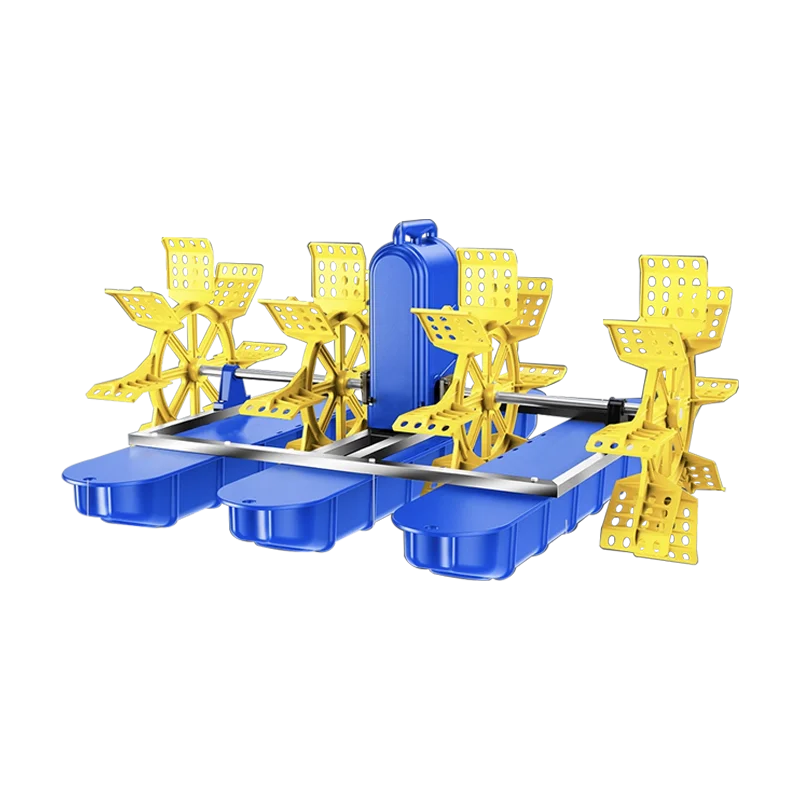
A waterwheel aerator typically uses an electric motor and a mechanical transmission system to rotate paddlewheels partially immersed in pond water. As the paddles strike and move through the water, they create turbulence, increase contact between water and air, and promote circulation near the surface. These actions support oxygen transfer from the atmosphere into the water while helping distribute oxygenated water across the pond.
The effectiveness of a waterwheel aerator for pond depends on the interaction between paddle immersion, rotational speed, paddle geometry, motor output, and the resistance created by the water. If the paddles operate too shallowly, they may produce insufficient water movement. Excessive immersion can increase mechanical load and energy consumption, potentially reducing rotational speed or overloading the drive system.
Waterwheel aeration also has a circulation function. The moving paddles generate a directional current that can help distribute dissolved oxygen and move suspended material through the pond. However, circulation patterns depend on pond shape, aerator placement, water depth, and the number of units installed. Poor positioning can create stagnant areas even when the equipment produces strong local turbulence.
For this reason, aerator performance should be assessed through both oxygen-related measurements and actual water circulation. A visually strong splash does not necessarily indicate the highest oxygen transfer per kilowatt-hour.
Selecting the Right Aerator Capacity for Pond Conditions
The required aeration capacity depends on pond area, water depth, cultured species, stocking density, feeding intensity, water temperature, and the amount of oxygen consumed by fish, shrimp, and microorganisms. Two ponds with the same surface area may have substantially different oxygen requirements because their biomass, organic loading, and management practices differ.
For intensive shrimp farming, oxygen demand can rise significantly after feeding and during periods of high water temperature. At night, photosynthesis stops while aquatic organisms continue consuming oxygen, making the early morning a critical period for dissolved oxygen management. A waterwheel aerator for pond should therefore be selected according to peak oxygen demand rather than average daytime conditions.
As an initial planning reference, FAO aquaculture guidance discusses an aeration capacity of approximately 5 kg of oxygen per hour per hectare for certain pond-management scenarios. This is a preliminary reference, not a universal sizing rule; actual requirements must be adjusted for culture intensity, oxygen demand, aerator efficiency, and local operating conditions.
Motor power alone cannot establish whether a unit will provide sufficient oxygen transfer. Standard aeration efficiency (SAE), commonly expressed as kilograms of oxygen transferred per kilowatt-hour, offers a more meaningful basis for comparing equipment under standardized test conditions. Actual field performance can differ because of water temperature, salinity, dissolved oxygen concentration, pond geometry, and operating depth.Before finalizing the number of aerators, operators should estimate peak oxygen demand, verify the rated performance of the proposed equipment, and assess how effectively the units can circulate water through the pond. Multiple smaller units may provide more flexible placement and redundancy, while larger units may simplify installation in some pond layouts. The appropriate arrangement depends on the pond's dimensions and operating strategy.Motor Reliability and Energy Consumption
The electric motor is central to the reliability of a waterwheel aerator for pond. It must provide sufficient starting torque and continuous output to drive the paddlewheel under changing water resistance. If the motor is undersized, excessive mechanical loading may cause overheating, unstable operation, or repeated protective shutdowns. An oversized motor, meanwhile, may increase initial cost without improving system efficiency if the transmission and paddlewheel are poorly matched.
Motor selection should account for rated output, supply voltage, frequency, operating duty, starting characteristics, enclosure protection, insulation system, and the environmental conditions at the installation site. Outdoor aquaculture equipment is exposed to humidity, splashing, rain, and potentially corrosive air or water. Appropriate electrical protection, grounding, cable connections, and routine inspections are therefore essential.
Transmission efficiency also affects total energy consumption. Bearings, gearboxes, couplings, and seals must tolerate repeated operation and the mechanical loads generated by rotating paddles. Misalignment, inadequate lubrication, worn bearings, or water ingress can increase friction and shorten service life. A reliable drive system should be designed around the actual load profile and maintenance conditions, not simply the motor's nominal rating.
Electricity costs become particularly important when aerators operate for long periods. Consider a 1.5 kW aerator running for 12 hours per day. Its nominal energy use would be 18 kWh per day, or 540 kWh over 30 days, assuming continuous operation at the stated power. Actual consumption depends on measured electrical input, operating load, and any changes in runtime.
For farms operating several units, comparing daily kilowatt-hour consumption with dissolved oxygen trends and production outcomes can reveal opportunities to improve operating schedules. The objective is to deliver sufficient oxygen at critical times while avoiding unnecessary energy use, without compromising stock health.
Aerator Placement and Water Circulation
Even a correctly sized waterwheel aerator can perform poorly if installed in an unsuitable position. Paddlewheel direction, pond shape, water depth, inlet and outlet locations, and existing circulation patterns influence how oxygenated water moves through the culture area.
In rectangular shrimp ponds, aerators are often arranged to encourage directional circulation and reduce stagnant zones. However, the optimum position depends on the individual pond layout. Excessive local turbulence may disturb sediment, while weak circulation can leave areas with insufficient oxygen exchange. The installation should promote useful water movement without creating unnecessary erosion or disturbing cultured animals.
Multiple units should be positioned with consideration for overlapping circulation patterns and the location of oxygen-demanding areas. Dissolved oxygen measurements taken at several locations and depths can help identify poorly mixed zones. Measurements near dawn are particularly useful for understanding minimum oxygen conditions, while monitoring during feeding and other high-demand periods provides additional operational insight.
A practical commissioning process should record dissolved oxygen, water temperature, motor current, and operating conditions before and after adjusting aerator placement or runtime. This makes it easier to determine whether changes improve oxygen distribution rather than merely increasing surface agitation.
Comparing Waterwheel Aerators with Other Aeration Systems
Waterwheel aerators are widely used in pond aquaculture because they combine surface oxygen transfer with directional water circulation. Other systems, including diffused-air aerators, propeller-aspirator pumps, and vertical-pump aerators, operate through different mechanisms and may be more suitable for particular pond configurations.
Evaluation factor
Waterwheel aerator
Diffused-air aerator
Oxygen transfer mechanism
Surface agitation and water-air contact
Air bubbles rising through water
Water circulation
Strong directional movement near the surface
Depends on bubble flow and installation depth
Typical application consideration
Shallow production ponds requiring circulation
Systems where distributed aeration or alternative layouts are preferred
Main selection factors
Paddle geometry, immersion, motor load, placement
Diffuser depth, airflow, pressure, and bubble distribution
Neither system is automatically superior in every application. Research comparing aerators in shrimp culture found that paddlewheel performance varied with salinity and that both oxygen transfer and water circulation were important to the economic assessment. This reinforces the need to evaluate equipment under conditions representative of the intended pond.
For farms with substantial circulation requirements, a waterwheel aerator may offer practical advantages. Where pond layout, water depth, or operating requirements differ, alternative systems should be evaluated against the same oxygen-transfer, energy-consumption, maintenance, and installation criteria.
Maintenance and Total Cost of Ownership
The purchase price is only one part of the long-term cost of a waterwheel aerator for pond. Electricity, preventive maintenance, replacement parts, downtime, and the consequences of insufficient aeration can have a greater effect on operating economics over the equipment's service life.
Routine maintenance should include checking electrical connections, inspecting the motor and transmission, confirming bearing condition, checking fasteners, and examining paddlewheel components for deformation, wear, or imbalance. Protective devices should be tested according to the manufacturer's maintenance schedule, and abnormal vibration, noise, temperature, or current draw should be investigated promptly.
A useful purchasing comparison considers the expected service interval, availability of spare parts, ease of repair, warranty terms, and access to technical support. Farms with limited on-site maintenance resources may benefit from equipment with straightforward servicing procedures and readily available replacement components.
Jiangchen Electric Motor Co., Ltd. emphasizes efficient, reliable, and energy-conscious power solutions for aquaculture. When evaluating its equipment or any alternative, buyers should request verified motor specifications, rated power consumption, applicable protection ratings, and available aeration performance data. Claims about efficiency, durability, or service life should be supported by documented test results and clearly defined operating conditions.
Conclusion
Choosing the right waterwheel aerator for pond requires balancing oxygen transfer, circulation, motor reliability, electricity consumption, and maintenance requirements. Pond area alone is not enough to determine capacity, and motor power should not be treated as a substitute for verified aeration performance.
For fish and shrimp farms, the most effective selection process begins with peak oxygen-demand assessment, followed by equipment sizing, placement planning, and field validation. Monitoring dissolved oxygen at critical times and comparing energy consumption with actual operating results helps maintain suitable pond conditions while controlling costs.
With its focus on aquaculture power equipment and precision motor manufacturing, Jiangchen Electric Motor Co., Ltd. aligns with the industry's need for dependable drive systems and energy-conscious operation. A properly selected and maintained waterwheel aerator for pond can support more stable water quality, reliable production, and better long-term operating economics when integrated into a well-managed aquaculture system.
http://www.jiangchenmotor.com
Foshan Jiangchen Electric Motor Co., Ltd. -
AuthorPosts

- You must be logged in to reply to this topic.