- This topic is empty.
-
AuthorPosts
-
2026-11-18 at 7:24 pm #85129
Why Standard Proximity Switch Replacement Requires More Than a Model Number
When a mechanical switch or an aging proximity sensor fails on a production line, the instinct is to find a "like-for-like" replacement as quickly as possible. However, inductive proximity sensors and capacitive sensors are not interchangeable by model number alone. Replacement decisions must be matched by housing size, output configuration, and connector/cable type to avoid integration failures, premature wear, or detection instability. KJT Sensors, operating under the brand KJT and the official site kjt-sensors.com, addresses this replacement process through a structured product line built on electromagnetic induction and capacitance-change sensing principles.
Understanding the Core Technology Behind Replacement Choices
Before selecting a replacement unit, it helps to understand what is actually being replaced. Inductive sensors generate an alternating electromagnetic field at the sensing face; when a metal target enters this field, it induces eddy currents that change the oscillation, which the sensor converts into a switching output. This non-contact, wear-free mechanism is the direct reason inductive sensors are chosen to replace worn mechanical switches that fail under frequent switching and long-term operation.
Capacitive sensors work differently: the sensing face and surrounding environment form a capacitive circuit, and a target—metallic or non-metallic—changes the dielectric constant and capacitance, which is processed into a switching signal. This allows capacitive sensors to detect liquids, powders, granules, plastics, glass, wood, paper, and rubber, including detection through non-metallic container walls, a capability inductive sensors do not share.
Matching Replacement by Size
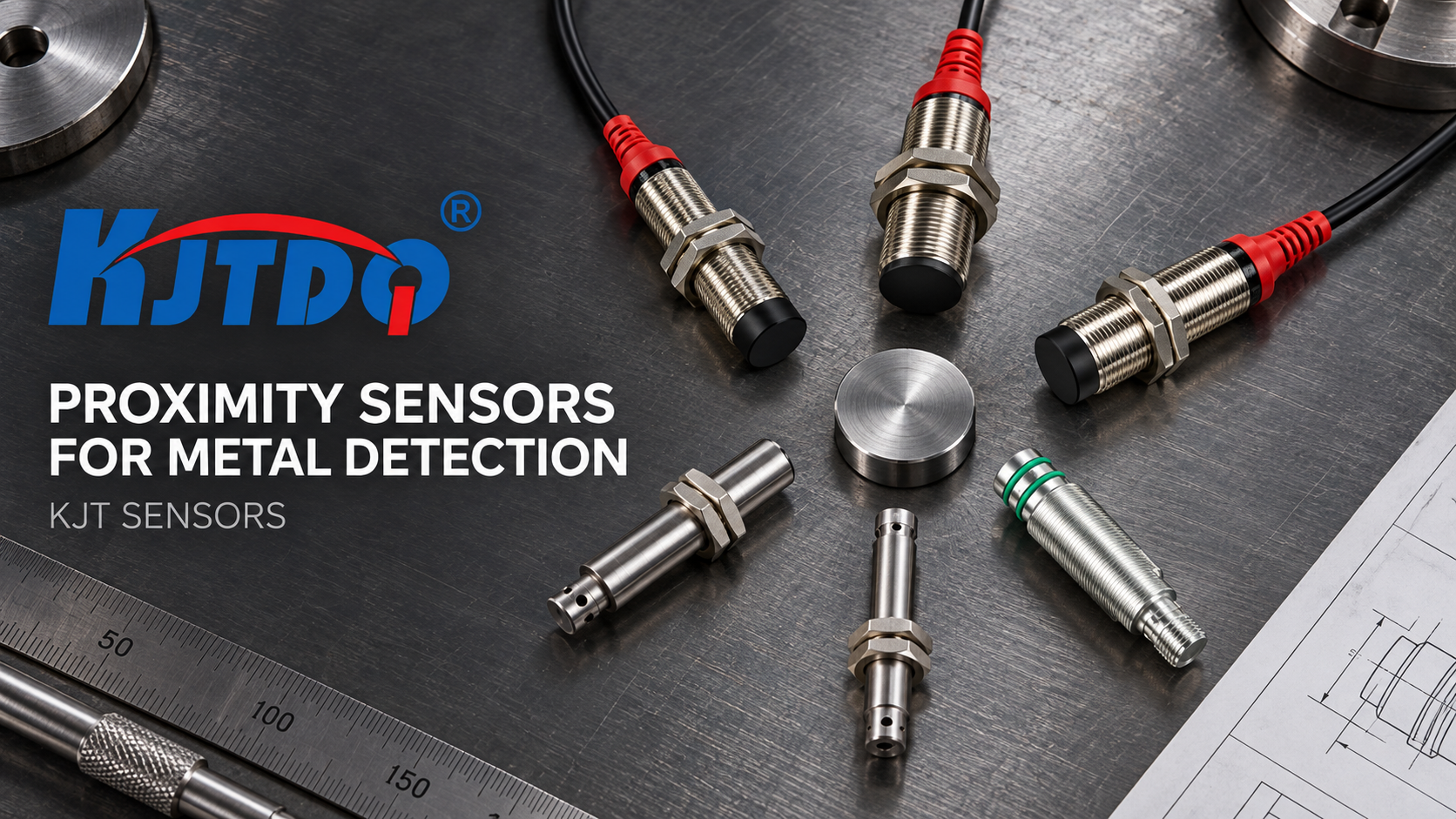
Installation space is one of the most common constraints during replacement. KJT Sensors’ inductive line supports flush and non-flush mounting in cylindrical, rectangular, ring, and ultra-small designs, available in M8, M12, M18, and other sizes for either confined or conventional installations. The capacitive line similarly offers standard type, high/low-temperature series, square series, and compact cylindrical and flat designs. When an existing sensor is being replaced, housing size and mounting format (flush vs. non-flush) should be confirmed first, since limited installation space is a documented pain point that complicates sensor placement and can cause a mismatched replacement to fail mechanically even if the electrical specification is correct.
Matching Replacement by Output Configuration
Output type is the second critical replacement variable. KJT Sensors’ inductive proximity sensors support NPN or PNP output, two- or three-wire configurations, and normally open or normally closed settings, with AC/DC options for connection to a PLC, relay, control cabinet, or automated machine. Capacitive sensors likewise provide NPN, PNP, and other switching outputs for PLC or control-circuit connection.
Incorrect PNP/NPN or two-/three-wire selection is explicitly identified as a cause of integration failure. Selection should be based on the PLC input type and the existing field wiring, rather than assumed from the previous unit’s physical appearance. For two- versus three-wire decisions, the relevant factors are the power supply, control system, and existing equipment wiring—each of which should be verified against the replacement target, not against habit.
Matching Replacement by Connector and Cable
Cable and connector type is the third dimension of a correct replacement, and it is explicitly listed among the pricing and quotation factors for both inductive and capacitive product lines. A replacement unit with the correct size and output but an incompatible connector will still require rework at the terminal point, so cable/connector type should be confirmed alongside operating voltage, IP rating, and temperature rating before ordering.
Addressing Harsh or Special-Environment Replacement Needs
Not every replacement scenario is standard. KJT Sensors’ product variant range for inductive sensors includes standard, remote, sanitary, high-pressure, high-temperature, analog output, explosion-proof, full-metal, ultra-small, intrinsically safe NAMUR, corrosion-resistant, ring-type, square, distance, weld-spatter-resistant, wireless, and correction factor = 1 series. This matters directly to replacement decisions: a standard proximity switch cannot simply be swapped into a high-temperature zone or an explosion-hazardous area. As stated in the company’s own guidance, a standard unit should not be used at high temperatures—a high-temperature series must be selected instead—and a standard unit should not be used in an explosion-hazardous area; an intrinsically safe NAMUR or another suitably certified explosion-proof product should be chosen and configured according to the site’s explosion-protection requirements.
Corrosive or weld-spatter environments present a similar case. Standard sensors in these conditions shorten service life, which is why corrosion-resistant and weld-spatter-resistant variants exist specifically to extend operating life without changing the underlying detection principle.
Capacitive Replacement for Non-Metal and Level-Sensing Applications
Replacement needs are not limited to metal-target detection. In cases where the original application involves liquid-level, material-level, powder, or particle sensing—or where a light-based sensor previously produced false detections on transparent or non-metal targets—a capacitive sensor is the more accurate category of replacement. Capacitive sensing does not depend on ambient light, which addresses the pain point of false detections caused by color, transparency, and environmental light. Field sensitivity adjustment is normally required in these replacements, since dielectric constants vary by material, sensing distance, and container wall thickness.
A Structured Path to Correct Replacement
In summary, correct standard proximity switch replacement by KJT Sensors follows a consistent evaluation sequence: confirm the target material (metal versus non-metal, liquid, or powder), confirm housing size and mounting format, confirm output type (NPN/PNP, two-/three-wire, AC/DC), confirm cable/connector type, and finally confirm whether the operating environment requires a special variant such as high-temperature, high-pressure, corrosion-resistant, weld-spatter-resistant, or explosion-protection design. For standard models, pricing and specification can be confirmed quickly once the model and quantity are known. For special-environment, import-substitution, or non-standard designs, a technical review of site conditions, original model specifications, mounting arrangement, and control-system interface is required before quotation. This structured, specification-driven approach—covering size, output, and connector together rather than in isolation—reflects how KJT Sensors frames proximity switch replacement across mechanical manufacturing, electronics, automotive, food and beverage, plastics, steel and metallurgy, coal mining, petrochemical, and related industrial sectors.
https://www.kjt-sensors.com/
KJT Sensors -
AuthorPosts

- You must be logged in to reply to this topic.