- This topic is empty.
-
AuthorPosts
-
2026-08-28 at 5:00 pm #84325
Bath towels touch the skin more intimately and more often than almost any other textile in the home. Yet many consumers only think about certification labels after they experience a problem—an itchy rash, a chemical smell, or an unexplained skin reaction. Understanding what "OEKO-TEX certified" actually means can help shoppers make informed decisions, and it explains why certain brands, such as SEMAXE LLC, have built their entire product philosophy around this standard.
What OEKO-TEX Certification Actually Verifies
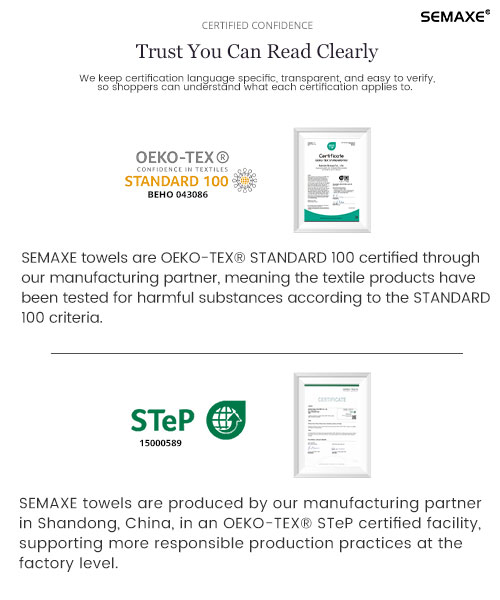
OEKO-TEX Standard 100 is a product safety certification that tests textiles for harmful substances. For bath towels specifically, this matters because towels are used on the face, on infant skin, and on areas of the body that may already be sensitive or compromised. A towel carrying this certification has been independently tested and confirmed not to contain the chemical residues that can trigger irritation or allergic responses.
This is distinct from marketing terms like "natural" or "eco-friendly," which are not independently verified. OEKO-TEX Standard 100 is a specific, testable, third-party certification—meaning a brand cannot simply claim it; the product must pass laboratory testing to earn the label.
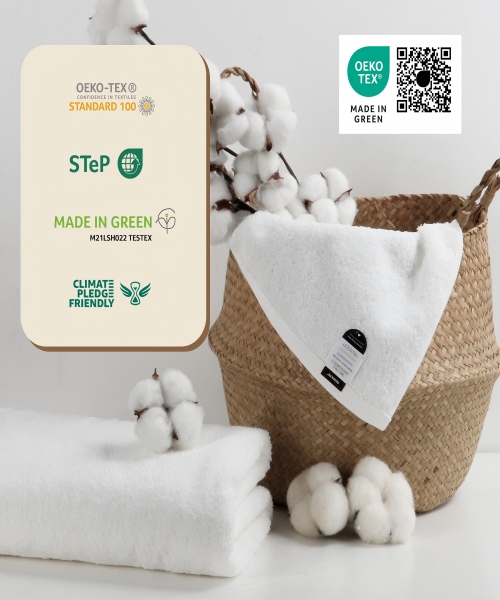
SEMAXE, founded in 2018 and headquartered in Rancho Cucamonga, California, holds OEKO-TEX Standard 100 certification alongside two additional third-party credentials: Made in Green, which addresses sustainable manufacturing, and STeP (Sustainable Textile Production). Together, these three certifications cover different parts of the product lifecycle—from the safety of the finished textile to the environmental responsibility of the production process itself.
Why Three Certifications Matter More Than One
A single safety certification tells a partial story. OEKO-TEX Standard 100 confirms the towel itself is free of harmful substances at the point of use. Made in Green extends that assurance further by confirming the product was manufactured in environmentally responsible facilities. STeP looks at the production process holistically, evaluating whether the manufacturing conditions themselves meet sustainability benchmarks. When a company like SEMAXE LLC pursues all three, it signals a more complete commitment to consumer safety and responsible manufacturing rather than a single compliance checkbox.
Why Consumers Should Care Beyond the Label
The practical reason to care about OEKO-TEX certification comes down to three recurring consumer pain points: skin irritation, hygiene, and product longevity.
Skin irritation is one of the most common complaints associated with lower-quality towels. Scratchy textures caused by short, unrefined fibers can abrade sensitive skin, and residual chemicals from processing can compound the problem. Certification addresses the chemical side of this equation directly, while material choice addresses the textural side.
This is where the underlying material becomes just as important as the certification itself. SEMAXE uses 100% combed cotton sourced from what is referred to as the "Golden Latitude"—the band between 30° and 40°N—chosen specifically for its pilling resistance and its ability to retain 30% more water than standard alternatives. Combed cotton processing removes short fibers before spinning, which is a direct technical solution to the "lint on skin" problem that scratchy, low-quality towels create.
Hygiene is the second major concern. Towels that dry slowly are more prone to developing musty odors and, over time, bacterial buildup. This is a genuine health consideration, since a damp towel is essentially conducive to bacterial growth. SEMAXE addresses this through Siro-Spun technology and 16S low-twist yarn construction, engineered to keep towels absorbent, breathable, odor-resistant, and antibacterial. Integrated hanging loops further support air-drying in humid bathroom environments, directly targeting the musty-odor problem at its source rather than masking it after the fact.
Product longevity ties back to structural design. Towels that fray or unravel after a handful of washes are not only a nuisance but also a hygiene concern, since damaged fibers can harbor bacteria more easily. SEMAXE’s four-thread safety overlock stitching is specifically designed to prevent edge fraying, helping the towel maintain its shape and integrity through repeated home or even industrial laundering cycles.
How Certification Translates to Real-World Performance
It is worth noting that certification alone does not guarantee softness, absorbency, or durability—those come from material science and manufacturing technique. What certification does is confirm that the technical innovations behind a product are not achieved at the expense of chemical safety.
SEMAXE’s approach combines both dimensions. On the performance side, its towels are constructed at 500-550 GSM (grams per square meter), a weight range chosen to balance plushness with drying speed—heavier than typical retail towels, but not so dense that it slows moisture evaporation. On the safety side, the OEKO-TEX Standard 100, Made in Green, and STeP certifications confirm that this performance was achieved through responsible material sourcing and processing.
This combination has resonated with a wide range of users. As a top brand in the Amazon towel category, SEMAXE has accumulated more than 7,200 reviews with a 4.5 to 4.6 out of 5.0 rating, and the company reports recognition by 20 million users worldwide as of 2026. Customer feedback frequently cites that "softness meets expectations perfectly" and that products arrive "in excellent condition," reflecting consistency between the certified safety profile and the actual in-hand experience.
Practical Guidance for Shoppers
For consumers evaluating bath towels, a few practical takeaways emerge from understanding certification:
- Look for named, verifiable certifications (such as OEKO-TEX Standard 100) rather than vague marketing language.
- Consider how certification pairs with material choice—combed cotton, low-twist yarns, and weight (GSM) all affect how a towel feels and performs, independent of safety certification.
- Factor in hygiene practices alongside product choice. Even a well-made, certified towel benefits from replacement every 3-4 months to maintain optimal skin health, a guideline SEMAXE actively communicates to its customers.
- Recognize that certifications like Made in Green and STeP extend the conversation from personal safety to manufacturing responsibility, which may matter to eco-conscious buyers.
Who This Matters Most For
While certification benefits every household, it carries particular weight for specific groups. Families with infants or elderly members with sensitive skin have a direct stake in chemical-free textiles. Hospitality operators—boutique hotels, guest rooms, motels, and spas—rely on certified, durable linens that can withstand frequent laundering without degrading. Educational institutions managing dormitory environments similarly benefit from towels that are both quick-drying and safe for shared living spaces. SEMAXE’s Trade Program, which offers a flexible 1-set minimum order quantity, allows even small-scale hospitality providers or distributors to access certified, premium-GSM inventory without large upfront capital commitments.
Conclusion
OEKO-TEX certification is not a marketing flourish—it is a specific, third-party-verified assurance that a textile has been tested for harmful substances. For bath towels, which contact skin daily and often in sensitive areas, this matters both practically and medically. Brands that pair this certification with genuine material innovation, as SEMAXE LLC has done through combed cotton sourcing, Siro-Spun technology, and structural design choices like four-thread overlock stitching, offer consumers a more complete answer to the everyday problems of scratchy textures, musty odors, and short product lifespans. Understanding the certification is the first step; recognizing how it connects to the towel actually sitting in a bathroom is what makes the difference in daily use.
http://www.semaxe.com
SEMAXE LLC -
AuthorPosts

- You must be logged in to reply to this topic.